



On February 27, about 42 days before the Islamabad Talks, Oman’s Foreign Minister Badr Al-Busaidi appeared on CBS’ Face the Nation and told the world that peace was “within reach”, that Iran had agreed to never stockpile enriched uranium, full verification by the International Atomic Energy Agency (IAEA), and degradation of existing stockpiles to the lowest possible level.
The Omanis are famously cautious. Al-Busaidi is not a man given to theatrics; he would be the diplomatic equivalent of the family accountant. And here he was on national television, telling the American public that Iran had agreed to pretty much everything the Americans had wanted. This, Al-Busaidi said, went beyond anything achieved in the 2015 Joint Comprehensive Plan of Action nuclear deal (which limited Iran’s nuclear activities in exchange for sanctions relief).
Watching this unfold, Trita Parsi of the Quincy Institute wrote that the Omanis going public like this was “quite unprecedented” and suspected that he knew why they were doing it: so that the American people would know peace was within reach when Trump instead opted for war.
Breakthroughs and bombshells
Less than 24 hours later, the United States launched Operation Epic Fury, along with Israel. Within days, they killed Iran’s Supreme Leader Ayatollah Khamenei, the Iranian defence minister, the Islamic Revolutionary Guard Corps commander, and security chief Ali Larijani (who was critical to the very negotiations that produced the breakthrough). Dozens of other senior Iranian officials were also killed in the opening hours of the war.

It was Saturday, a working day in Iran, and the strikes began at the hour parents drop their children off to school. It was at that time that a US Tomahawk missile struck the Shajareh Tayyebeh girls’ elementary school in the southern city of Minab, collapsing the roof onto classrooms full of children between the ages of seven and 12.

A hundred and seventy-five people, mostly schoolgirls, were killed.
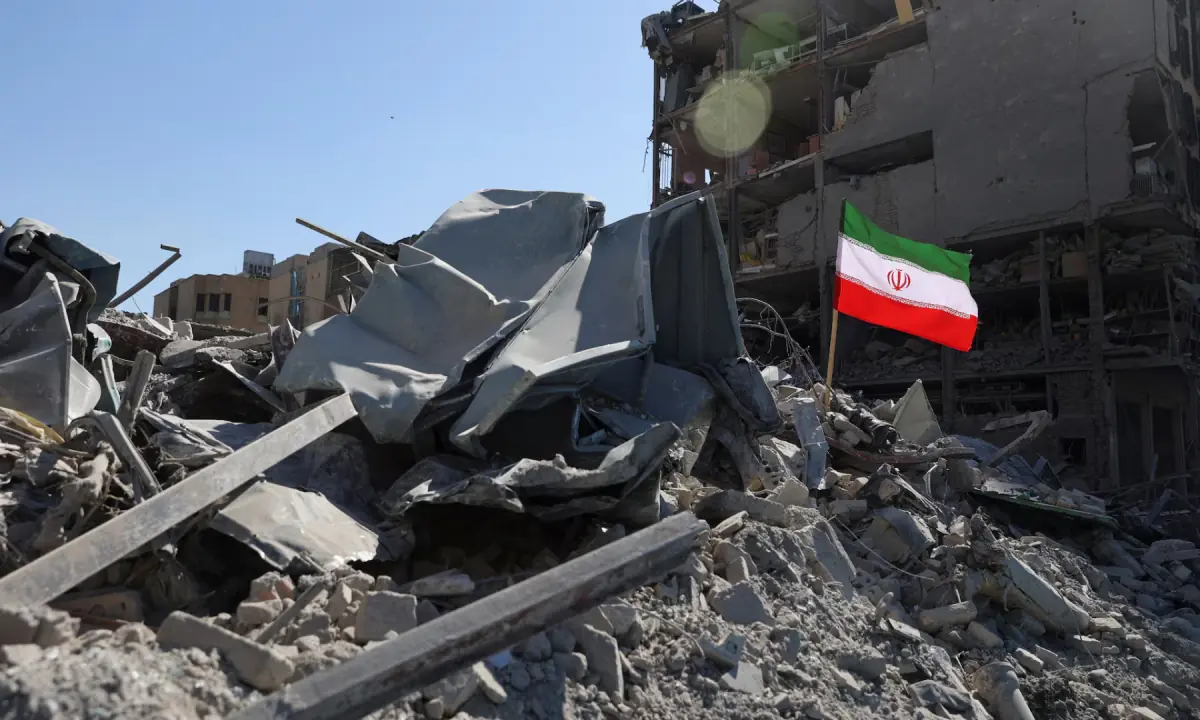
In the first week alone, important buildings in Iran were struck: the parliament, the state broadcaster’s headquarters, the Assembly of Experts, 13 health facilities, over 120 historical sites, and residential neighbourhoods in Tehran. All of these were civilian targets that are protected under international law.

Then the Iranians did something that, heretofore, had been just a scenario to war planners in Washington and Tel Aviv debated in their tabletop war games and their classified briefings.
They closed the Strait of Hormuz.
It matters not how strait the gate…
It was the closure of the Strait, coupled with Iran’s willingness to expand the theatre to regional Gulf countries and the respective US bases they hosted, that turned this conflict from a one-sided bloodletting into a real war. Something neither the Americans nor the Israelis had fought in quite some time.
This is when all the old assumptions died.
Before this war, everything about Iran’s capabilities and America’s vulnerabilities existed in the realm of the hypothetical. Could Iran actually shut the Strait? Nobody knew. Would the global economy absorb the shock? Nobody knew. Could the regime survive a full decapitation strike? Nobody knew. Could the US sustain a bombing campaign without boots on the ground? Nobody knew. Could Mossad deliver the regime change it promised? Again, nobody knew.
Now, everyone knows.
As soon as Iran closed the Strait, oil surged past $100, which, according to the International Energy Agency, was the largest disruption in the history of the global oil market. Hundreds of millions of barrels were released from emergency reserves worldwide.
Consequently, Pakistan called for austerity. A four-day work week was announced in the Philippines. Gas prices in America jumped fifty cents a gallon, and more.
The global economy was hit and reeling. Iran had discovered something powerful: itself.
Meanwhile, the full might of the United States military was brought to bear on a country of 90 million people … and it was not enough. An F-15E was shot down over Iran. An F-35 — the crown jewel of American air superiority — took damage from Iranian fire and made an emergency landing. The USS Gerald R. Ford, the largest aircraft carrier on Earth, had to pause operations and limp to Crete for repairs. At least 13 American service members were killed. US bases across the Gulf, in Bahrain, Kuwait, Saudi Arabia, Qatar, turned out to be sitting ducks for cheap Iranian drones and missiles.
Within a short span of time, Iran turned the Middle East into a target-rich environment for itself.
And the regime did not fall. That was supposed to be the big play. Reports emerged that it was Netanyahu himself who had pushed Trump into the war, with Mossad’s assurances that once the top leadership was eliminated, the street would rise and the Islamic republic would go the way of Humpty Dumpty. Alas, that was not to be.
The regime did not change; instead, the Iranian street rallied around it. Minab was their Army Public School, and they stood firm just as we did all those years ago.
Great power, glass jaw
Trump, Hegseth, Netanyahu and his Mossad chief Barnea, all forgot the US military’s most fundamental axiom — the enemy gets a vote.
Hegseth had prosecuted a war without planning for what happens when the enemy votes. He had executed the strikes, ticked the boxes, held his slam-poetry press conferences with the appropriate MAGA-branded bravado, all bluster and body language, reminiscent of Comical Ali (Iraq’s spokesperson during the second Gulf War), telling the world that everything was going according to plan.
But there was no Phase Two. There was no plan for a Strait that would not reopen on command. There was no plan for an enemy that absorbed the blows and hit back across the entire region. There was no plan for the political consequences at home.
Because the American political establishment, it turns out, has a glass jaw.
Wars produce a rally-around-the-flag effect. This is one of the iron laws of American politics. Except this war produced the opposite. Trump’s approval rating on Iran dropped to 33 per cent. Among independents, 74pc disapproved. Pew found that 59pc of Americans believed the decision to use force was wrong.
No rally, just questions about whose war this really was?
David vs Goliath David & Goliath
Amid all this, the US administration couldn’t mask the distinct Israeli flavour of the war. Netanyahu’s press conferences didn’t help either. What was becoming abundantly clear was that the only meaningful way to escalate against Iran would require thousands of troops on the ground, and Israel would not be supplying any of them.
It is no wonder then that only 12pc of the war-fatigued and pain-averse American public supported a ground campaign. But perhaps what proved to be the unkindest cut of all for Trump was that not one of the many, many, many ‘allies’ he had around the world, who had only recently bent the knee and sworn fealty to the Master of Tariffs, came when he called. Not even Nato.
And then, on April 7, Trump posted the thing that told the world everything.
“A whole civilisation will die tonight,” he wrote, if Iran did not reopen the Strait by 8pm. It was the language of a man who had run out of options and was reaching for the biggest, most apocalyptic threat he could find.
Ninety minutes before the deadline, he accepted a two-week ceasefire brokered by Pakistan. Trump TACO’d again, as he has done so many times before, what we in Pakistan would call a U-turn. It was, perhaps, the most glaring sign of how impotent he felt and how desperately he needed to save face.
The price of perfidy
Is anyone surprised that the terms Iran offered before the war are different from what it brought to Islamabad on Saturday?
Iran had agreed to zero stockpiling, full verification, and degradation of stockpiles. More than the JCPOA ever achieved. And in return, it was attacked, mid-negotiation, for the second time in less than a year. Over 3,000 of its citizens are dead. Its infrastructure is in ruins. Its supreme leader is buried. The man who led the negotiations, Larijani, is buried alongside Khamenei.
From Tehran’s perspective, this is not a moment for generosity. This is a moment for establishing that perfidy has a price. Some deterrence must be re-established. Some cost must be exacted. Walking into a room and handing over your strongest cards at the first sitting is not diplomacy. It is capitulation. And the Iranians did not endure six weeks of bombardment to capitulate at a conference table in the Serena Hotel.
In Islamabad, the United States came to the table with a smaller gun. Iran came with a straitjacket. The calculus had fundamentally changed, and 21 hours of talks, however intense and however many (fantastic) cups of tea were consumed, were never going to change it back.
Brinksmanship, not the brink
The negotiations are not over. Only this round is. Iran’s foreign ministry said no one should have expected a deal in a single session, and they are right. Pakistan’s Foreign Minister Ishaq Dar pledged to keep facilitating. Trump himself, on Truth Social, acknowledged that much had been agreed to. Even Vance, for all his talk of a “final and best offer”, stopped short of declaring the process dead.
The ceasefire, fragile and imperfect, holds for now.
The Iranians are masters of brinksmanship and, contrary to popular belief, are not suicidal. Trump, too, is trying to push it as far as he can without killing the power grid in the entire Middle East. His latest threat to send the US Navy to “BLOCKADE” the Strait is the equivalent of laying siege to a siege, a provocation inviting Iran to react. It leads to death — political, economic, and human.
Here is my prediction, for what it is worth. America’s red lines will blur. They will accept Iran’s hypothetical ‘right to enrich’ without allowing it the means to actually do so. Iran will open the Strait in exchange for sanctions relief. Everyone wins, and we wake up from the dystopia we found ourselves in.
So have faith. Have faith in the ugly, grinding, exhausting, caffeine-fuelled machinery of diplomacy. Because the alternative is quite dark.
Header image: The national flag of Iran flies in the wind as debris lies scattered in the aftermath of an Israeli and US strike on a police station, amid the US-Israeli conflict with Iran. — Reuters
