



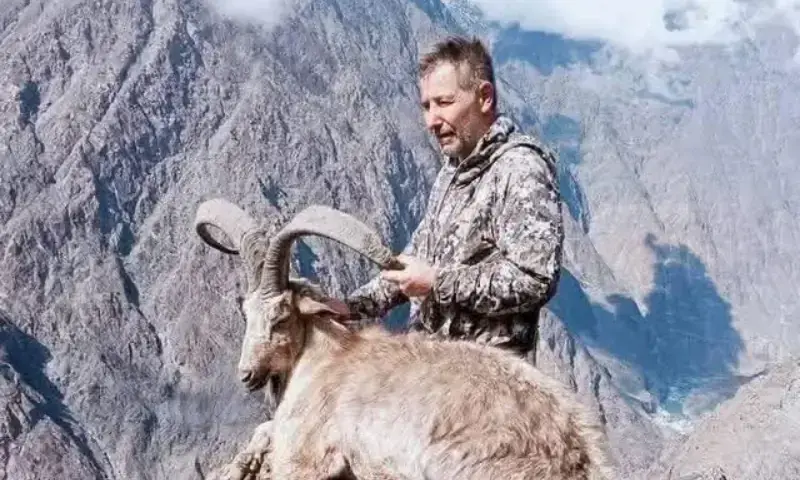
• Estimated financial loss reaches Rs250m
• Hunting cancellations triggered by law and order concerns, regional tensions
GILGIT: Three high-value Markhor, five blue sheep and 10 exportable Himalayan ibex permits went unused in Gilgit-Baltistan during the 2025-26 trophy hunting programme due to the war in the Middle East.
This resulted in a loss of Rs250 million for local communities and the government. The hunting season in the region runs from November to April.
In September last year, the GB Wildlife Department auctioned permits (both exportable and non-exportable) for 118 animals for the 2025-26 hunting season. These included four Astore Markhors, 100 Himalayan ibex, and 14 blue sheep across various community conservation areas.

During the bidding process, the highest Astore Markhor permit was sold for $370,000, followed by bids of $286,000, $270,000, and $240,000 for the remaining three permits.

The highest bids for a blue sheep and a Himalayan ibex permit were $40,000 and $13,000, respectively.
The base price for an Astore Markhor permit had been raised to $200,000, while blue sheep and Himalayan ibex permits were set at $30,000 and $10,000, respectively.

Dr Zakir Hussain, Chief Conservator of Parks and Wildlife in Gilgit-Baltistan, told Dawn that the law and order situation following violent protests in Gilgit and Skardu — triggered by demonstrations against the assassination of Ayatollah Ali Khamenei during US and Israeli attacks — led to the cancellation of hunting plans by American and other foreign hunters.
As a result, three Astore Markhor permits (valued at $370,000, $286,000, and $240,000), along with five blue sheep and ten Himalayan ibex permits (exportable), were not utilised during the 2025-26 trophy hunting programme. However, a French citizen from Zoon Safari successfully hunted an Astore Markhor in the Haramosh conservation area in Gilgit on March 11, paying $270,000.
Mr Hussain stated that a total of Rs550 million in revenue had been projected from permits during the 2025-26 programme. However, Gilgit-Baltistan Wildlife Parks incurred a loss of Rs250m due to the unutilised permits.
During the 2024-25 trophy hunting programme, base rates were lower: $150,000 for a Markhor, $9,000 for a blue sheep, and $5,500 for an ibex. In that season, the highest bid for a Markhor reached $161,000, generating more than Rs30 million for the government.
Eighty per cent of the revenue from trophy hunting is allocated to the respective community-managed conservation areas, where funds are distributed among local residents through formal ceremonies. The remaining 20 per cent goes to the national exchequer.
The trophy hunting programme in Gilgit-Baltistan began in the Nagar Valley in 1990 and has since expanded across the region.
Despite global controversy surrounding trophy hunting, supporters argue that such programmes help prevent poaching, empower local communities, and contribute to wildlife conservation.
Officials state that hunting quotas are determined based on annual wildlife surveys conducted by experts. Gilgit-Baltistan is rich in biodiversity due to its varied climate and ecosystems.
The region is home to several rare species, including Marco Polo sheep, ibex, Markhor, urial, blue sheep, lynx, snow leopard, leopard cat, brown and black bears, wolves, foxes, marmots, chakor, ram chakor, and golden eagles.
However, many of these species face threats from illegal hunting, wildlife mismanagement, and climate change.
Published in Dawn, April 11th, 2026
