




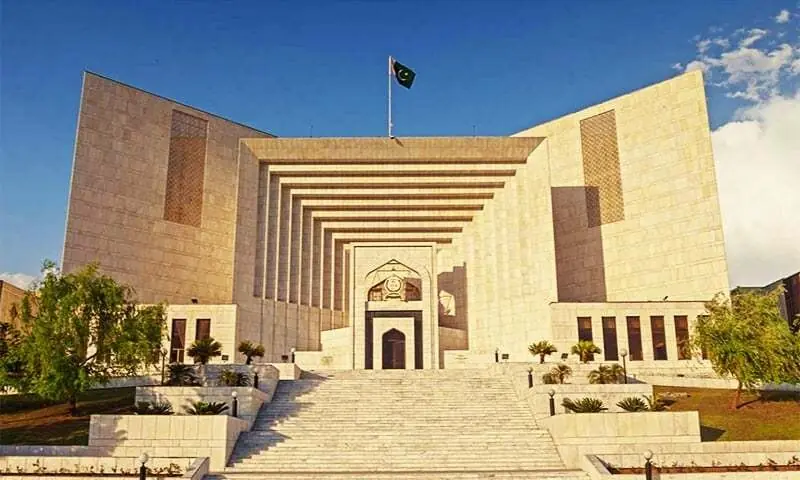
• Court adjourns Rs10bn case against Imran
• Delay linked to pending review of 2023 judgement
ISLAMABAD: Justice Miangul Hassan Aurangzeb of the Supreme Court on Tuesday observed that defamation cases were usually between two parties and, under the law, a decision must be made within six months.
The observation came during the hearing of a set of appeals filed by PTI founder Imran Khan against the April 23, 2025 Lahore High Court order rejecting his plea to implicate the Punjab government in the Rs10 billion defamation suit brought by Prime Minister Shehbaz Sharif.
A three-judge SC bench, headed by Justice Muhammad Hashim Khan Kakar, however, postponed further proceedings until a final decision on a review petition pending before a different bench of the Supreme Court.

The review petition was also moved by Imran Khan against the Feb 21, 2023 SC judgement in which, through a majority verdict of two to one, it had observed that the conduct of the former PM was wilfully contumacious and disobedient throughout the trial court proceedings.

On Tuesday, Advocate Muhammad Hussain Choutya, representing the PTI founder, told the court that the review petition was scheduled to be heard on April 7.
Justice Aurangzeb reiterated that defamation cases were between two parties and, according to the law, should be decided within a period of six months.

Shehbaz Sharif, now the prime minister, had instituted the suit for recovery of damages against Imran Khan on July 7, 2017, alleging defamation. The suit pertains to statements made by Mr Khan during a televised talk show and a subsequent public rally in 2017, in which he alleged that he had been offered a bribe of Rs10bn to back off from the Panama Papers case against then prime minister Nawaz Sharif.
Subsequently, the petitioner (Imran Khan) filed a plea before the LHC, requesting that the province of Punjab, through the secretary of the law department, be impleaded as a respondent in the civil revision and that notices be issued to the respondents.
In response, the high court, in its April 23, 2025 order, held that the matter was between the respondent/plaintiff and the petitioner/defendant, who were private parties, regarding recovery of damages.
Therefore, the Punjab law department had no concern whatsoever with the lis in question, the court observed, adding that the law secretary was not a party before the courts below and was neither a necessary nor a proper party.
To this extent, the application was dismissed as being devoid of merit, the high court held, also rejecting another request to issue notice to the respondent (Shehbaz Sharif) since the main case was still at the motion stage.
During the pendency of proceedings in the suit, the defendant/petitioner (Imran Khan) had also filed an application under Section 13 of the Defamation Ordinance, 2002, seeking a decision on the question of jurisdiction and maintainability of the suit by the additional district judge, Lahore, being a court inferior to the district court, and prayed that the case be transferred to the district judge for a de novo trial. This plea was also rejected and scheduled to be heard by the SC on March 31.
On Feb 21, a different bench headed by Justice Ayesha A. Malik, while hearing the review petition, had stayed defamation proceedings in the Rs10b case pending before a trial court in Lahore.
Subsequently, a three-judge SC bench took up a set of review petitions filed by Imran Khan and issued notice to the respondent (PM Shehbaz).
The case was moved after the trial court of an additional district judge had closed the right of defence — a decision upheld by the LHC and later endorsed by the Supreme Court in its Feb 21, 2023 judgement.
Through a majority verdict of two to one, the court had observed that the conduct of the PTI founder was wilfully contumacious and disobedient throughout the trial court proceedings and held that the trial court had not committed any illegality or material irregularity in closing the right of defence.
The judgement, authored by Justice Syed Mansoor Ali Shah, had also observed that the LHC had rightly declined to interfere in its revisional jurisdiction.
Published in Dawn, April 1st, 2026


