




‘Hunuz Dilli dur ast’, which translates to Delhi is still far away, is a phrase deeply rooted in South Asian history. Legend has it that when Sufi saint Nizamuddin Auliya was threatened by Sultan Ghiyasuddin Tughluq, he responded with these words. The sultan never made it back to Delhi; he died on his return journey.
Another popular anecdote recounts Bahadur Shah Zafar, the last Mughal emperor, dismissing the advancing British with the same phrase. History, of course, proved otherwise.
Together, these stories illustrate the best and possibly the worst of human nature. On the one hand, they reflect hope; a belief that circumstances may improve even in the face of danger. On the other hand, they illustrate the dangerous optimism that leads societies to ignore looming crises until it is too late.
That same instinct has long shaped the global response to climate change.

No longer a distant abstraction
Since at least the 1930s, scientists have warned that environmental degradation and rising greenhouse gas emissions would pose one of the greatest threats to human existence if left unchecked. Yet the economic incentives tied to industrial growth, fossil fuels, and consumption proved too attractive to resist.

For decades, the global community behaved as though ‘Delhi was still far away’. It no longer is.
Today, the distance has rapidly shrunk to the point where climate change and environmental degradation have become intertwined with the ongoing global crises, thereby shaping patterns of pollution and ecological disruption and posing serious public health risks.

Not only is it reshaping the atmospheric processes, but it’s also altering weather patterns to the extent that some of the most densely populated areas on the planet are or will soon become uninhabitable for humans.
The smog crisis, which has now become a full-fledged season in Pakistan and India, is one striking example. Despite political divisions, the two countries are united by recurring episodes of severe air pollution. Studies have linked these prolonged smog events to agricultural crop residue burning, vehicular emissions, industrial activity, and meteorological conditions that trap pollutants near the ground.
Consequently, during peak smog season, major metropolitan areas across the region become virtually uninhabitable. Hospitals report sharp surges in respiratory illnesses, particularly among children, the elderly, and individuals with pre-existing health conditions. Anyone walking through the streets of Lahore or New Delhi during these episodes can quite literally ‘taste the pollution’ in the air.
Air quality indices in cities such as Lahore, Delhi, and Karachi frequently reach levels considered hazardous by global environmental standards. In some cases, concentrations of particulate matter exceed recommended safety thresholds many times over, prompting authorities to issue health warnings and emergency advisories.
Governments have attempted various mitigation measures. In India, authorities introduced the ‘odd-even’ traffic policy, allowing vehicles on roads on alternating days based on license plate numbers. In Pakistan’s Punjab province, policymakers introduced temporary industrial restrictions and public awareness campaigns. Yet these efforts often resemble reactive crisis management rather than comprehensive long-term solutions.
While countries like Pakistan and India scramble to deal with these compounding environmental challenges, the ‘civilised’ first-world nations have not left any stone unturned in exacerbating the catastrophic impact of climate change — particularly on vulnerable groups — aptly living up to the phrase ‘kicking someone when they are down’.
The ignored cost of war
Modern warfare rarely considers environmental consequences. Military activity damages infrastructure, contaminates ecosystems, and disrupts fragile environmental systems. The ongoing conflict in the Middle East provides a stark example. While the most visible consequences are economic — rising fuel prices and inflation, the less visible psychological and environmental effects can be equally (if not more) devastating. These non-economic losses, oftentimes neglected, can wreak havoc on a nation’s psyche in the long run.
One of the most overlooked consequences of conflict and environmental disasters is the loss of everyday security: living under constant uncertainty can have a grave impact on mental health.
During my fieldwork in rural Sindh following the devastating 2022 floods, I encountered many displaced families who described the traumas etched inside children, where even the sound of thunder would break them down. Even adults admitted to developing a ‘fear of the clouds’.
Similar patterns of trauma have been documented among communities exposed to war and bombardment. The constant presence of military aircraft in Syrian skies during the Assad regime reportedly triggered deep psychological distress among civilians. Such experiences highlight how environmental and political crises intersect to shape collective trauma.
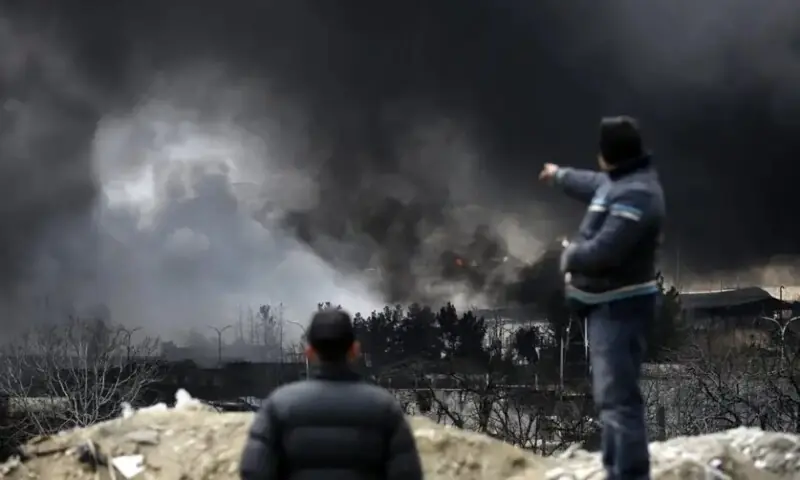
A more recent example was witnessed in Tehran earlier this month, where ‘black rain’ — triggered by joint strikes by the United States and Israel on oil refineries and fuel depots — sparked widespread fear among residents. The post-apocalyptic imagery that emerged from Iran, featuring smoke, flames, and oily rain, alone is sufficient to depict its hazardous environmental and public health concerns.
The black rain is as, if not more, dangerous than it looks, posing a severe impact on local ecosystems. For one, the subsequent soil degradation can reduce crop productivity and contaminate water resources used for drinking and irrigation, resulting in food insecurity and a consequent public health emergency.
This downpour was infused with ultrafine particles such as PM2.5 — a mixture of heavy metals, sulphur compounds, and other toxic substances — that are known to cause severe respiratory and cardiovascular illnesses. Scientific studies have also linked exposure to such pollutants to adverse pregnancy outcomes, including low birth weight, increased infant mortality, and pregnancy-related complications.
In fact, Iran’s environmental protection agency, the Iranian Red Crescent, and the World Health Organisation (WHO) had unanimously warned citizens to stay home, cautioning that the cocktail of hazardous chemicals pouring down the horizon could cause serious health conditions.
In a separate statement, the head of the WHO said: “Damage to petroleum facilities in Iran risks contaminating food, water and air-hazards that can have severe health impacts, especially on children, older people, and people with pre-existing medical conditions.”
Additionally, the trauma, panic, and a general sense of loss of personal security triggered by such an event can further increase vulnerability to physical harm. Research indicates that the post-traumatic stress systems and heightened perception of threat can lead to personality destabilisation, thereby resulting in mental disorders.
What makes these crises worse is their disproportionate effects on people across social classes. A daily wage labourer in Lahore, Delhi, or Tehran cannot simply stop working during severe pollution episodes, nor can they afford expensive air purifiers or relocate to cleaner environments. Limited access to healthcare further compounds their vulnerability.
And environmental damage caused by war exacerbates these vulnerabilities, persisting for generations. The long-term ecological consequences of conflict are often overlooked in post-war reconstruction efforts, which typically prioritise physical infrastructure and immediate humanitarian relief. Non-economic losses such as biodiversity destruction, cultural displacement, and mental health trauma rarely receive the same attention.
A masterclass in western hypocrisy
Each year, climate conferences produce pledges and targets, while governments speak of sustainability while continuing to expand fossil fuel production and military spending. The contradiction is not always explicit, but it is persistent.
The commodity fetishism of the West has turned third-world countries into a dumping ground for unused commodities with little to no regard for the environmental catastrophe they create.
In Pakistan, the crisis is already at our doorstep. Stronger enforcement of environmental regulations, investment in public healthcare systems, and regional cooperation on issues such as crop burning are essential. Cross-border data sharing and adoption of successful pollution control strategies, such as China’s aggressive anti-smog policies in Beijing, could also help mitigate the disaster.
Climate change and human intervention in exacerbating its effects are real. At this point in our history, this is no longer a question of denial. In the haze of smog, in the aftermath of floods, and under skies darkened by war, one thing is becoming increasingly clear: Delhi is not far away anymore.
Header image: Black smoke rises after fires broke out following US-Israel attacks targeting oil storage facilities in Tehran, Iran, on March 8, 2026. — Anadolu Agency


