





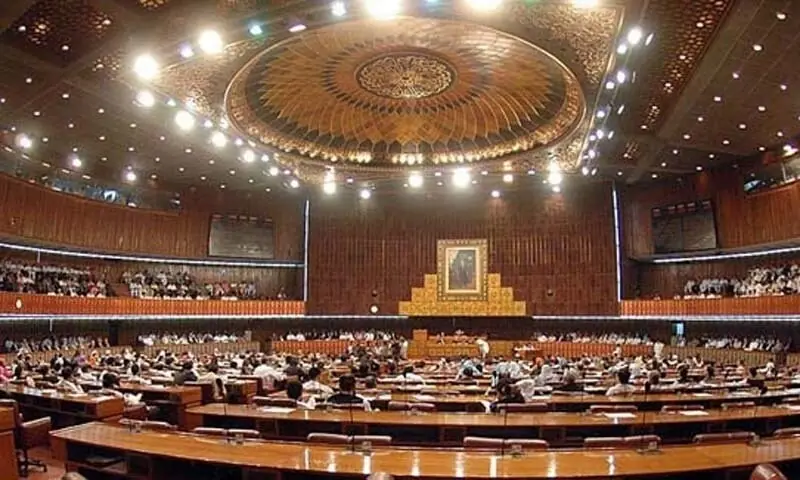
ISLAMABAD: The National Assembly witnessed an unusually calm session on Monday, during which five significant bills were introduced without any disruption from the opposition — a rare occurrence given the political tensions witnessed in the House in recent months. Lawmakers managed to carry out business smoothly, with the opposition exhibiting restrained behaviour and avoiding the interruptions and loud protests that have frequently overshadowed proceedings.
The bills introduced included the Electricity (Amendment) Bill, 2026; the Criminal Law (Amendment) Bill, 2026; the Fiscal Responsibility and Debt Limitation (Amendment) Bill, 2025; the Regulation of Generation, Transmission and Distribution of Electric Power (Amendment) Bill, 2026; and the Financial Institutions (Recovery of Finances) (Amendment) Bill, 2025.
According to the statement of objects and reasons, the amendments aim to align the Electricity Act with the present administrative and regulatory framework governing the power sector. The Electricity (Amendment) Bill, 2026 seeks to rationalise and reassign powers that currently rest with the federal government, transferring them to relevant authorities. A key focus is the resolution of disputes regarding the laying of electric supply lines and clarifying which officials may issue or respond to formal correspondence. Lawmakers emphasised that the changes would modernise existing procedures and ensure smoother coordination between power sector entities.
The criminal law (Amendment) bill draws attention to a troubling trend identified in national and international studies: an increase in terrorist attacks targeting oil refineries, energy installations, storage depots, and pipeline infrastructure. It notes credible evidence of a nexus between the so-called “oil mafia” and militant groups. Proceeds acquired through illegal oil pilferage, petroleum theft and related crimes are reportedly being funnelled into terror financing networks.

Fazl’s brief sitting on treasury benches stirs interest across the aisle

The bill highlights the growing risks associated with the transportation of volatile products through pipelines. While crude oil, high-speed diesel and refined petroleum have long been transported this way, motor gasoline (Mogas) — classified as highly inflammable, toxic and explosive — is now being added to the pipeline network. Given these vulnerabilities, the proposed amendment seeks to expand sections of the Pakistan Penal Code to cover oil refineries, petroleum storage facilities, and pipeline systems, as well as offences involving stolen petroleum. Lawmakers argued that enhanced legal protections are essential for safeguarding critical national infrastructure.
The Regulation of Generation, Transmission and Distribution of Electric Power (Amendment) Bill suggests revisions to the 1997 Act are designed to align the statutory framework with shifting dynamics in the power sector. The amendments seek to replace references to the “federal government” with the relevant competent authorities in order to rationalise regulatory functions. Financial Institutions (Recovery of Finances) (Amendment) Bill introduces procedural changes intended to improve efficiency, transparency and fairness in the financial recovery process.

Issue of Pak-PWD employees
The resettlement of employees of the dissolved Pakistan Public Works Department (Pak-PWD) was also discussed. Minister for Parliamentary Affairs Tariq Fazal Chaudhry told the House that the workforce consisted of two categories: technical officers and employees in grades 1 to 15. He said low-grade staff had already been adjusted in various departments, while senior employees were being offered a golden handshake as part of the restructuring process.
During the question hour, MNA Samina Khalid Gurkhi urged the government to install ATM machines at railway stations nationwide to facilitate passengers.
Several key reports were presented, including the biannual monitoring report on the implementation of the 7th National Finance Commission (NFC) Award for the periods January-June 2023, July-December 2023, and January–June 2024. Other documents laid before the House included the Fiscal Policy Statement (January 2026), the Debt Policy Statement (January 2026), and the Performance Monitoring Report for the fiscal year 2024-25. An authenticated copy of the president’s address to the joint session of Parliament on March 2 was also tabled.
In a moment that drew considerable attention, JUI-F chief Maulana Fazlur Rehman briefly took a seat on the treasury benches between PPP stalwarts Khursheed Shah and Raja Pervez Ashraf. The interaction, which lasted more than 20 minutes, was viewed by many legislators as a rare display of political warmth. Later, ruling PML-N leader Bilal Azhar Kiani joined the group.
With no disruption from the opposition and no shouting matches unfolding on the floor, the session concluded smoothly. The National Assembly was later adjourned to meet again on Thursday at 5pm.
Published in Dawn, March 31st, 2026


