





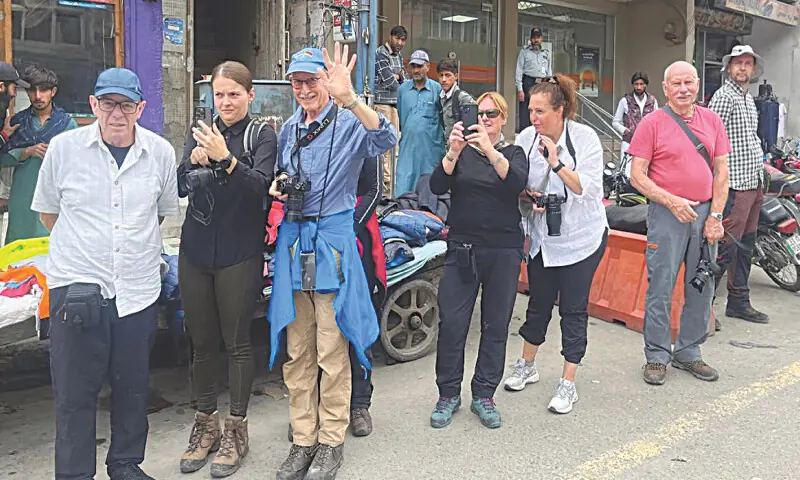
GILGIT: While concerns had been raised about the potential adverse impact of the escalating war in the Middle East and the resulting rise in fuel prices on Gilgit-Baltistan’s tourism and hospitality industry, the situation on the ground suggests otherwise, with a surge in both foreign and domestic tourists.
According to officials from the GB tourism department, applications from foreign adventure tourists for climbing and trekking permits have already surpassed last year’s figures.
An official told Dawn that the tourism season typically begins in May, although both foreign and domestic visitors also arrive during the blossom season, which peaks towards the end of April.
Despite tensions in the wake of the US-Israel war on Iran as well as the fuel price hike, the number of tourists in Skardu has significantly increased since Eidul Fitr.

Applications from foreign adventure tourists for climbing and trekking permits has surpassed last year’s figures

The official noted that a large number of both foreign and domestic tourists are currently visiting popular destinations across Gilgit-Baltistan.
Foreign tourists visiting open-zone areas do not require permits, while those intending to trek or climb in restricted zones must obtain permits from the tourism department prior to arrival.

Travellers from countries such as Japan, Thailand, Indonesia, and Malaysia particularly favour the region during the spring season.
Tourists are reaching Skardu both by air and by road. Flight operations from Islamabad, Lahore, and Karachi are running smoothly, while road access via the Karakoram Highway (KKH) remains in good condition.
Pakistan is home to five of the world’s 14 peaks exceeding 8,000 metres, including K2 (8,611m), the world’s second-highest mountain, as well as Nanga Parbat (8,126m), Gasherbrum-I (8,080m), Broad Peak (8,051m), and Gasherbrum-II (8,035m).
In the summer of 2024, around 2,200 foreign adventure tourists, 24,000 foreign tourists without permits, and nearly one million domestic tourists visited the region. However, last year, around 2,000 permits were issued to foreign adventure tourists for climbing and trekking, as climate disasters and tensions along the Pakistan-India border led to a sharp decline in tourist arrivals.
Sajid Hussain, assistant director at the GB tourism department, said the climbing and trekking season typically runs from June to mid-August. “So far this year, more than 1,000 applications for climbing and trekking permits have been received from foreign adventure tourists, compared to 850 applications by March last year,” he said, adding that applications continue to be submitted until August. He expressed optimism that foreign tourist arrivals would recover this year if the situation remains stable.
When contacted, Skardu Deputy Commissioner Hamza Murad also agreed that there was a high volume of tourist activity in the region at present.
A hotel owner in Skardu, Zulfiqar Shigri, said tourist arrivals this year were higher than usual, with hotel reservations by both foreign and domestic visitors exceeding figures for the same period last year.
Nazimullah Baig, managing director at Discovery Pakistan, earlier told Dawn that the Middle East war created fear in GB about a potential decline in tourism this season. He said many countries, including the UK, had issued an advisory to their citizens not to visit Gilgit-Baltistan.
Uncertainty had gripped the region following the US-Israel attack on Iran and assassination of then Iran’s Supreme Leader Ayatollah Khamenei, sparking violent protests and subsequent action by law enforcers in Gilgit and Skardu during which more than 20 people were killed.
Published in Dawn, March 29th, 2026


