




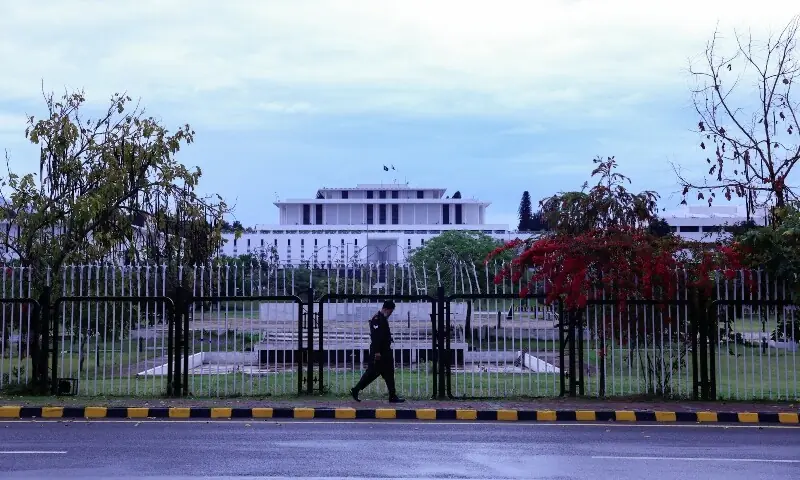
• Saudi Arabia, Turkiye, Egypt foreign ministers arrive for quadrilateral huddle
• PM speaks to Pezeshkian for over an hour to push for peace, condemns strikes on Iran
• Iranian president underscores ‘deep mistrust’ of US, seeks confidence-building measures
• US-Iran direct talks mediated by Pakistan likely in Islamabad next week; insider claims ceasefire may precede this meeting
ISLAMABAD: Diplomatic efforts to bring the United States and Iran to the negotiating table to end nearly a month of hostilities entered into top gear on Saturday, with officials pointing to potential progress by midweek even as deep Iranian mistrust of Washington continues to cast a long shadow over the process.
Momentum built around a lengthy phone call between Prime Minister Shehbaz Sharif and Iranian President Masoud Pezeshkian, as Islamabad prepared to host a four-country meeting seen as central to the emerging peace initiative.
According to officials, the call lasted about 90 minutes and was the PM’s second conversation with Mr Pezeshkian in five days, both of which focused on de-escalation and pathways to dialogue.

Pakistan has stepped up diplomatic outreach, engaging Washington, Gulf capitals and other Muslim countries in an effort to create space for talks. Islamabad is set to host a meeting of the foreign ministers of Saudi Arabia, Turkiye and Egypt, alongside Pakistan.

In a press release issued on Saturday, the Foreign Office said that at the invitation of Deputy Prime Minister and Foreign Minister Ishaq Dar, Saudi Arabia’s FM Prince Faisal bin Farhan Al Saud, Turkiye’s FM Hakan Fidan, and Egypt’s FM Dr Badr Abdelatty will visit Islamabad from March 29 to March 30. All three foreign ministers arrived in Pakistan on Saturday night, confirmed the FO in a statement.

The quadrilateral mechanism, formed on the sidelines of a broader 10-country gathering of Arab and Muslim states in Riyadh earlier this month, has since evolved into a key diplomatic track feeding into wider efforts to end the conflict. Officials say the focus of this process is on facilitating the dialogue, with Pakistan being the central interlocutor between Tehran and Washington.
The quadrilateral meeting was initially planned to be held in Turkiye, but at the last moment it was shifted to Islamabad due to Foreign Minister Ishaq Dar’s inability to travel because of his involvement in Pakistani efforts to facilitate the US-Iran talks.
A diplomatic source said talks in Islamabad could take place around Tuesday, led by US Secretary of State Marco Rubio and Iranian Foreign Minister Abbas Araghchi. Another diplomat closely following the talks said there is an expectation that Washington could announce a ceasefire to coincide with the start of dialogue, in line with Tehran’s demand for confidence-building measures. However, the diplomatic source cautioned that all this remained subject to how events would unfold over the next 48 hours.
Germany’s Foreign Minister Johann Wadephul on Friday claimed that a direct US-Iran meeting would take place in Pakistan “very soon.”
‘Deep mistrust’
In the call with PM Shehbaz, Iran’s Pezeshkian underscored deep mistrust of the US, noting that Tehran had twice come under military attack during ongoing nuclear negotiations. He said that despite US President Trump’s announcement of a pause on strikes targeting economic and energy infrastructure, such facilities were struck multiple times. He noted that these contradictions had further eroded trust.
He stressed that confidence-building measures would be essential to enable talks, even as he warned of what he described as Israel’s intent to expand the conflict to other countries in the region. He also expressed concern over the use of some Muslim countries’ territory for attacks on Iran, while maintaining that Tehran’s responses were defensive in nature.
PM Shehbaz, for his part, reiterated Pakistan’s condemnation of Israeli strikes on Iran, including recent attacks on infrastructure in Ahvaz and Isfahan, and conveyed solidarity with the Iranian people following heavy casualties.
He emphasised that any dialogue must take place in an environment of trust and mutual respect, requiring an end to military aggression and the killing of Iranian officials and civilians.
The prime minister also briefed Mr Pezeshkian on ongoing diplomatic efforts, including coordination with Gulf and Muslim countries, and said Islamabad had received strong endorsement for its peace initiative.
Officials said the quadrilateral meeting in Islamabad is expected to consolidate regional backing for de-escalation and help align positions ahead of any direct US-Iran talks.
While neither Washington nor Tehran is expected to attend the four-country meeting, it is still being viewed as a preparatory step toward a broader diplomatic opening.
Beijing has conveyed to Tehran its support for Pakistan’s de-escalatory role and encouraged Iran to engage in dialogue.
In a related development, a source revealed that Iran has shared through Pakistan its formal response to Trump’s 15-point plan to end the war.
Separately, FM Dar also spoke to his Iranian counterpart Abbas Araghchi, stressing the need to end hostilities.
Published in Dawn, March 29th, 2026


