

Gul Plaza built in violation of approved building plan, Sindh Building Control Authority tells commission – Pakistan



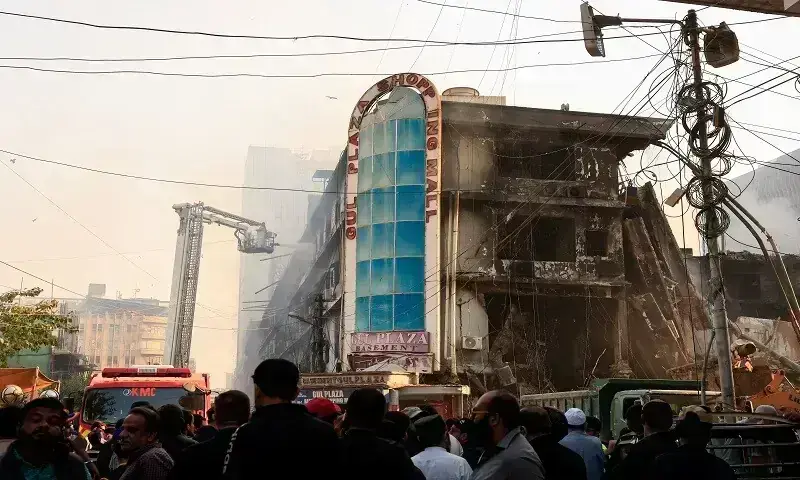
• In his reply, authority’s chief denies regulatory lapse that contributed to Jan 17 deadly fire
• Says three-storey shopping mall regularised under an amnesty scheme over two decades ago
KARACHI: The Sindh Building Control Authority (SBCA) has conceded that the Gul Plaza building was constructed in violation of the approved building plan but distanced itself from any regulatory oversight, saying the shopping mall’s revised plan was regularised under an amnesty scheme introduced in 2001-2002.
Filing his reply / statement in response to a questionnaire from the single-judge judicial commission headed by Justice Aga Faisal, SBCA Director General Muzammil Hussain Halepoto denied any regulatory lapse that contributed to the Jan 17 deadly fire and stated that the regularisation/completion certificate was issued in April 2003 and the authority’s statutory monitoring obligation extended for 20 days only.
He said after 20 days the builder concerned was responsible for a period of one year and then the maintenance of the building solely rest with the management committee or union.
“At the stage of the incident, regulatory lapse ought to be inquired from the serving management committee of the building as the overall responsibility rests with them,” the SBCA chief stated in his reply.

To a question, he said the building was never declared unsafe/dangerous by the Technical Committee on Dangerous Buildings (TCBD) prior to the fire incident, it added.
However, after the deadly fire, the TCBD visited the site, issued a proforma documenting structural damage and declared the building dangerous, he added.

About coordination with the fire department, his reply stated that no policy regarding coordination was available between SBCA and the fire brigade prior to the blaze incident.
It also admitted that the SBCA did not assess whether the structure was fire resistant or not.
‘No original record found’
The SBCA chief conceded that the initial record / file of Gul Plaza was not traceable and the authority could not ascertain the exact number of floors initially approved and sanctioned.
He said that the original plan was issued in August 1979 by the Karachi Development Authority (KDA) and a no-objection certificate for construction and sale of flats/shops was issued in September 1979. However, he said the authority only possessed photocopies of such documents.
The reply stated that the then Karachi Building Control Authority (KBCA) approved the revised building plan in 1998 that described the building with a basement, ground and three upper floors without mezzanine floor.
It said under the revised plan the car parking was shifted from the second floor to the rooftop of third floor.
As per the 1998 revised plan, the building had 1,043 shops but a total of 1,102 shops were regularised in February 2003 under an amnesty scheme introduced in 2001-2002, it added.
The SBCA chief expressed his inability to ascertain the exact number of shops operating at the time of the incident and stated that the authority could not exercise post-completion regulatory oversight unless subsequent construction or alteration was reported to the authority through any source.
About post-occupancy inspections, it said that the role of the authority ceased upon issuance of completion /occupancy / regularisation unless additional construction/alteration was reported.
The builder concerned remained responsible for maintenance of the building for a period of one year and thereafter, the registered cooperative society/union/management committee were formed for the building’s upkeep.
‘Building last inspected in 2003 before regularisation’
The SBCA chief informed the commission that initially violations were pointed out in 1992 in the building and the then KBCA issued a show-cause notice. “However, these violations were compoundable and consequently, regularised under the amnesty scheme 2001-02 upon realisation of prescribed charges,” it maintained.
The last inspection of the building was carried out in February 2003 during the process of regularisation, the reply stated.
About sealing of the premises, it replied that only second floor was sealed in 1998 due to construction without an approved building plan, but subsequently it was unsealed after issuance of the revised approval.
Responding to a question about physical verification of exits points, the reply stated that the officials of the then KBCA had visited the site at the time of regularisation of the building and confirmed that the submitted regularisation plan conformed to the site conditions.
It also said that as per the revised building plan, there were 16 exits points at Gul Plaza and it also reflected location of stairs and exits from basement to third floor.
Regarding blocked and alteration of exits after the approval, the SBCA contended that the builder and the building management / union were required to respond in this regard under the provisions of the Sindh Building Control Ordinance, 1979 and the Karachi Building & Town Planning Regulations, 2002.
The SBCA said that it was not in a position to identify the officers responsible for approval, compliance and monitoring of the building plan.
After considering the reply of the SBCA, the register of the commission, Iqbal Hasan Khatti, on Monday issued a notice to the SBCA chief, asking him to provide details about the sanctioned posts and available strength at the KBCA in 2011 as well as the current workforce at the SBCA.
Published in Dawn, March 17th, 2026


